
NC State team pairs drones and robots to fix cotton field gaps
A new automated system aims to cut replanting costs by targeting only the specific areas where seeds failed to sprout.
By Michael Bennett ·
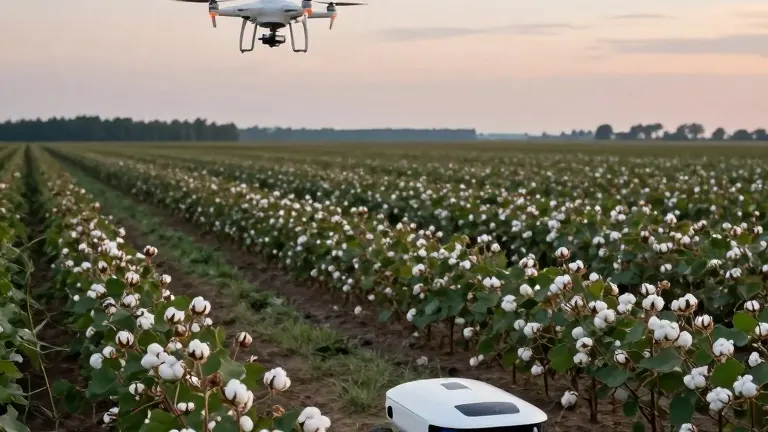
A research team at North Carolina State University has developed a system that uses an autonomous drone and a self-driving ground robot to replant gaps in cotton fields. The project targets a common agricultural problem where seeds fail to sprout, forcing growers to either accept lower yields or replant entire rows at high cost. By identifying and filling only the empty spaces, the team hopes to reduce labor and input expenses for farmers.
The initiative began with a need for more efficient field scouting. Project leader Frank Bai, an assistant professor of biological and agricultural engineering, noted that current methods for fixing skips are inefficient. Replanting one by one risks damaging healthy plants and increases labor costs. When gaps are widespread, growers often have no choice but to restart the planting process. The team sought an automated way to bypass these manual hurdles.
The operational workflow starts at the Sandhills Research Station in Jackson Springs, North Carolina. BAE research associate Justin Macialek launches the drone from a docking station, traveling from his office in Raleigh. Holding a rare beyond-the-line-of-sight license from the Federal Aviation Administration, Macialek monitors the aircraft remotely. The drone uses high-resolution cameras to capture images of every crop row. Artificial intelligence models then process these images to identify skips longer than three feet.
The data processing occurs on a local server rather than in the cloud, eliminating the need for time-consuming on-the-ground measurements. This setup is part of the Automating Intelligence from Research Stations project, which aims to strengthen digital infrastructure at state agricultural stations. Chris Reberg-Horton, NC State crop scientist and N.C. Plant Sciences Initiative platform director, and Jevon Smith, CALS research computing manager, helped establish the system. Smith stated that the technology helps farmers improve yields and reduce operating costs.
The team is currently testing the integration of this aerial data with ground-based robotics. The system uses a satellite location network accurate to within one inch to create a digital map of missing plants. An unmanned ground vehicle will receive this map and navigate the crop rows to drop seeds exclusively into the empty gaps. ShengDao Du, a doctoral student in biological and agricultural engineering, built the robot prototype and developed its navigation software.
Funding for the cotton gap project comes from Cotton Inc. The interdisciplinary team includes Jason Ward, Tommy Stephenson, and Robert Austin from NC State. Collins, a cotton specialist in the Department of Crop and Soil Sciences, emphasized the economic pressure on growers. He noted that seed costs exceed $100 per acre, making precise, timely replanting valuable. The team demonstrated the system in late September.
Bai’s lab is also applying similar drone technology to other crops. In collaboration with the U.S. Department of Agriculture, the team uses drones to measure evapotranspiration in soybean fields. This data helps identify drought-tolerant soybean lines. The work at Sandhills Research Station is particularly useful because the station’s porous Candor sand soil drains quickly, creating a stressed environment for plants. Station superintendent Jeremy Martin described the soil as a torture chamber that helps determine which plant varieties survive harsh conditions.
The research extends to three-dimensional plant phenotyping. Working with electrical and computer engineering professors Edgar Lobaton and Mike Kudenov, Bai and Yuxi Chen are developing models that measure complex traits like leaf angle and canopy height. These automated systems aim to provide farmers with tools to manage labor shortages and rising input costs. The team continues to refine the technology to ensure it is reliable and affordable for widespread agricultural use.